
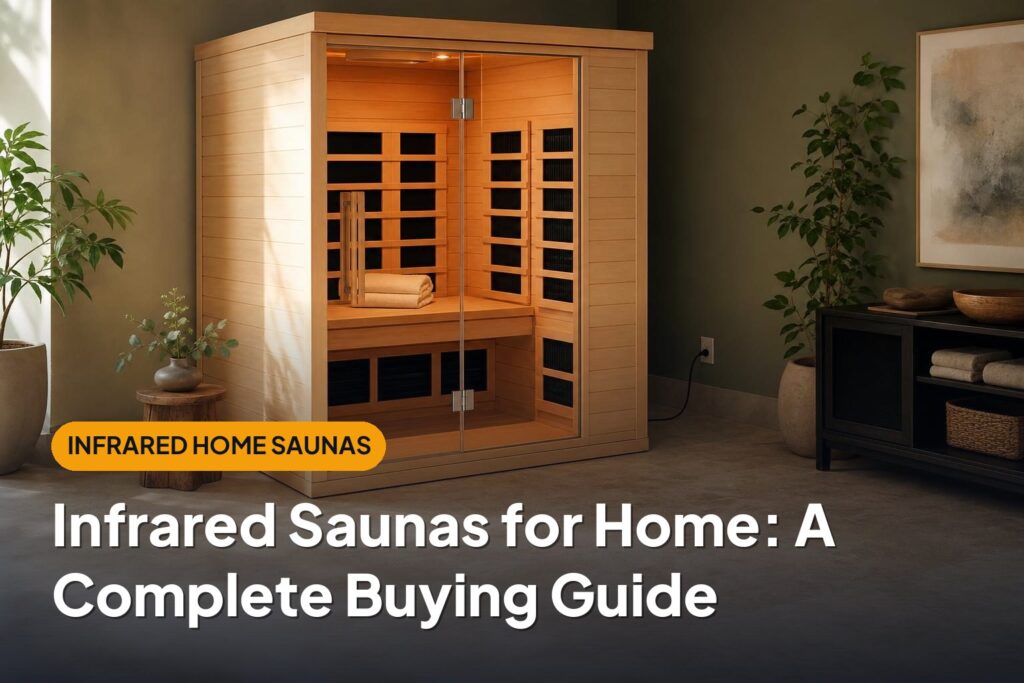
Choosing an infrared sauna for home means balancing comfort, space, electrical requirements, and budget—not simply picking the cabin with the most features. This guide explains how infrared saunas work, what separates the main types, and which details to check before ordering. Whether you want a compact solo retreat or a cabin to share, the goal is a sauna that fits your home and feels easy to use regularly.
1. Understand How Infrared Saunas Work
An infrared sauna uses electric emitters to deliver radiant heat to your body and surrounding surfaces. The cabin air also warms up, but the experience generally relies less on very hot air than a traditional sauna does.
A traditional sauna uses a heater—often with stones—to heat the room. In suitable traditional saunas, water can be added to the stones to create a temporary burst of humidity. Infrared cabins are generally designed for dry use: do not pour water onto their heaters unless the manufacturer explicitly permits it.
Infrared vs. traditional saunas
| Consideration | Infrared sauna | Traditional sauna |
|---|---|---|
| Heat experience | Direct radiant warmth at a lower air temperature | Hotter air, heated surfaces, and radiant heat from the heater |
| Typical cabin temperature | Often around 110–150°F, depending on the model | Often around 150–195°F, depending on the setup |
| Humidity | Usually dry, without water added to the heaters | Can include bursts of humidity when water is added to suitable stones |
| Electrical needs | Some compact models use a compatible household circuit; others need more capacity | Electric heaters commonly require a dedicated higher-voltage circuit |
Neither style is automatically better. Infrared may appeal if you prefer gentler air temperatures, while traditional sauna users may value intense ambient heat and the ritual of water on stones.
Be cautious with sweeping health promises. Sweating is a normal cooling response, not proof of “detoxification,” and immediate weight loss mainly reflects fluid loss. Research on sauna bathing does not establish that every infrared product delivers the same benefits, or that findings from traditional sauna use apply directly to infrared cabins.
2. Choose Your Infrared Type and Heater Design
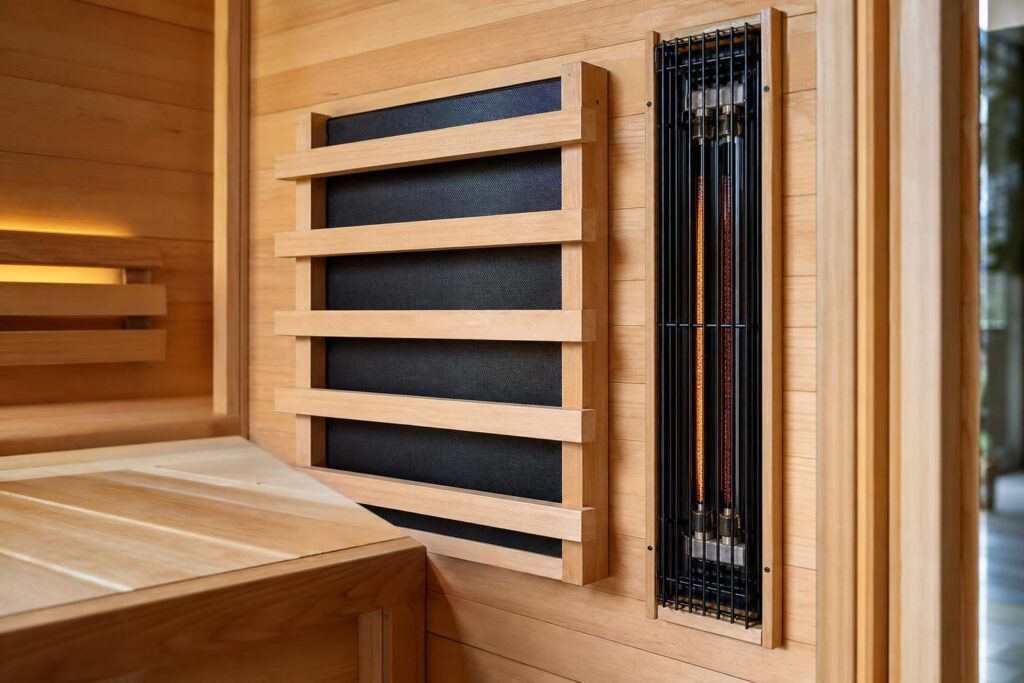
Two separate questions often get mixed together: which infrared wavelengths a sauna produces, and what its heaters are made from. Understanding the distinction makes specifications easier to compare.
Far-infrared vs. full-spectrum
Far-infrared saunas focus on longer infrared wavelengths and are a common option for home cabins. They can be a sensible choice if your priority is a straightforward, comfortable heating experience.
Full-spectrum saunas are marketed as providing near-, mid-, and far-infrared output. The emitter design, output, and ability to control different wavelengths vary between products.
Full-spectrum does not automatically mean a better purchase. Ask what hardware produces each wavelength range, whether the settings are independently adjustable, and what evidence supports any claimed advantage. A premium is easier to justify for controls and comfort you value than for vague wellness language.
Carbon vs. ceramic heaters
- Carbon-panel heaters: Often use broad panels distributed around the cabin. Their larger surface area can help spread radiant warmth across several seating positions.
- Ceramic heaters: Often use smaller, hotter emitting elements. Depending on placement, they may produce a more concentrated feeling of heat.
- Mixed systems: Some cabins combine heater types to balance coverage and intensity.
Neither material guarantees faster warm-up, better efficiency, or greater comfort. Heater area, operating temperature, power, distance from your body, and placement all matter.
Look for useful coverage around your back, sides, and legs. A high heater count means little if the panels are small or poorly positioned. If possible, sit in a demonstration cabin to judge comfort rather than relying on specifications alone.
3. Pick the Right Size for One or Two People
Advertised capacity is a starting point, not a comfort guarantee. A “two-person” sauna may seat two adults upright but leave little room to stretch, turn, or sit with bent knees.
Measure the interior, not just the footprint
For a one-person infrared sauna, check usable bench width, bench depth, legroom, and headroom. Think about how you actually want to sit. A compact upright cabin may work well for short sessions but feel restrictive if you prefer changing position.
When comparing two-person infrared saunas for home use, pay particular attention to:
- Usable bench width: Can both people sit without pressing against each other?
- Foot space: Is the floor area comfortable for two sets of legs?
- Heater coverage: Do both seats receive reasonably balanced warmth?
- Backrests and accessories: How much seating space do they occupy?
- Access: Is the doorway easy for both users to navigate?
A larger cabin may be worthwhile even for one person if you want more freedom of movement. However, do not assume a two-person model is long enough to lie down in; verify the usable dimensions.
Check the route into your home
Measure doorways, stair turns, elevators, and ceiling height along the delivery route. Ask for the dimensions and weights of the largest individual panels, not only the assembled cabin.
Also allow the installation and service clearances specified in the manual. A sauna that fits tightly into an alcove may still be unsuitable if there is no room to assemble it or access its components.
4. Plan the Location, Electrical Supply, and Installation
The best location is dry, accessible, and compatible with the sauna’s installation instructions. Common choices include a spare room, home gym, or suitable basement. Garages and outbuildings need extra scrutiny because temperature, moisture, and electrical conditions can vary widely.
Indoor and outdoor models are not interchangeable
Do not place an indoor cabin outdoors simply because it is beneath a roof. Outdoor installation requires a model explicitly designed for that environment, along with an appropriate base, weather protection, and electrical installation.
For any location, check:
- A level, stable floor that can support the cabin and occupants.
- Manufacturer approval for the floor surface and room conditions.
- Required wall and overhead clearances.
- Room ventilation to help manage warmth and moisture from use.
- Access to controls, electrical connections, and service panels.
Verify electrical requirements before buying
Some smaller infrared saunas connect to a suitable household outlet, but “plug-in” does not mean any available socket is appropriate. Voltage, current, receptacle type, and dedicated-circuit requirements vary by model and country.
Have a qualified electrician assess the installation if you are unsure. Follow the manufacturer’s requirements and local electrical rules, including any applicable ground-fault protection. Do not rely on extension leads or power strips.
Ask what assembly involves, how many people are needed, and whether professional installation is available. Delivery may stop at the curb rather than include carrying heavy panels into your chosen room.
5. Evaluate Build Quality, Safety, and Low-EMF Claims
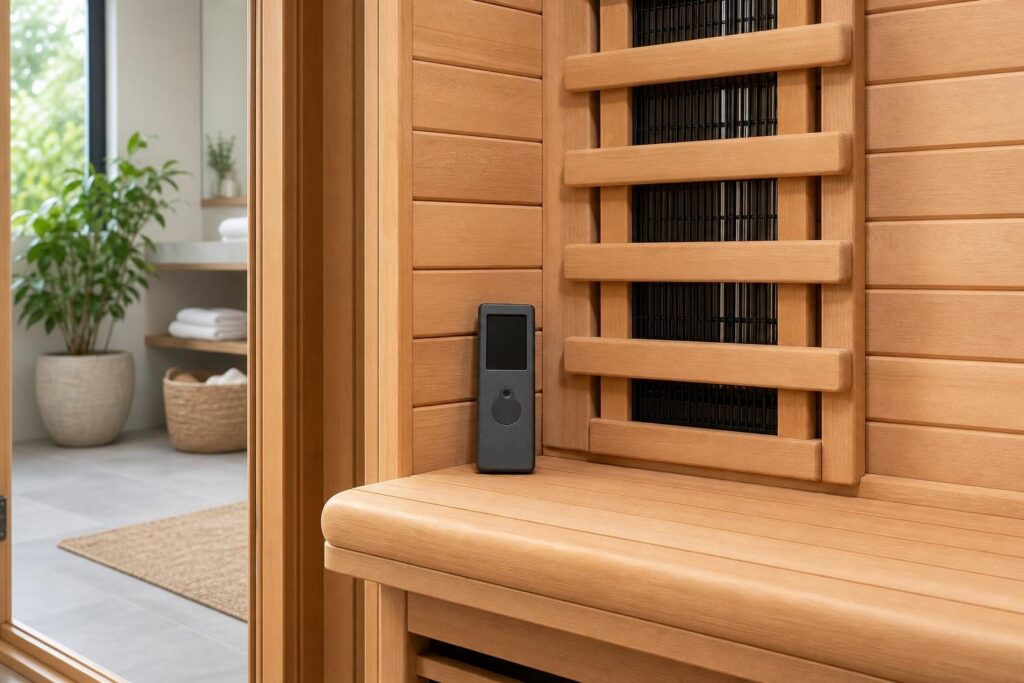
A good infrared sauna for home should be comfortable and straightforward to maintain. Decorative lighting and speakers are secondary to reliable heaters, sound construction, and accessible support.
Construction details that matter
- Wood and finishes: Ask which materials, adhesives, and finishes are used inside the heated cabin, especially if you are sensitive to odors.
- Seating: Look for a stable bench, comfortable edges, and practical back support.
- Door and glazing: Check the door’s operation, glazing specification, and any cold drafts around the seating area.
- Controls: Prioritize a clear timer, easy temperature adjustment, and controls you can reach comfortably.
- Serviceability: Ask whether heaters, controllers, and power components can be replaced individually.
- Electrical safety: Look for recognized third-party safety certification applicable to the complete product and your market.
What to check in a low-EMF infrared sauna
“Low EMF” is not a single, universally standardized product grade. A useful report should identify what was measured—such as low-frequency magnetic or electric fields—the units, instrument, operating conditions, and measurement locations.
Distance matters. A reading taken away from the cabin does not describe exposure at the bench, backrest, or floor. Ask for results at normal body positions with the heaters operating, and check whether they apply to the exact model you are considering.
Independent testing is more informative than an unexplained badge, but it still needs context. Do not confuse low-EMF marketing with electrical safety certification, or interpret a low reading as proof of a health benefit.
6. Compare Total Cost, Premium Features, and Established Options
The purchase price is only part of the budget. Include delivery, assembly, electrical work, floor preparation, accessories, and any charges for difficult access.
Estimate running costs realistically
Electricity consumption depends on the sauna’s power draw and operating time, including preheating. A basic estimate is:
Power in kilowatts × operating hours × your electricity rate = estimated electricity cost.
For illustration, a sauna drawing 1.5 kW continuously for 45 minutes would use 1.125 kWh. Actual consumption may differ because heaters can cycle or adjust output. Include warm-up time when estimating a full session.
Infrared cabins often have lower rated power than traditional electric sauna heaters, but that does not guarantee a particular saving. Compare the actual models, session lengths, starting conditions, and electricity tariff rather than relying on broad efficiency claims.
When premium models deserve a closer look
The Clearlight Sanctuary 2 is a two-person model worth considering when comparing premium full-spectrum cabins. Check its current exterior dimensions, usable seating space, electrical requirements, heater arrangement, and installation clearances against your room.
The Sunlighten mPulse range is another established option for buyers exploring full-spectrum saunas and more elaborate controls. The key question is whether its particular configuration and features justify the premium for your intended use.
For either option—or any alternative—verify the current specification sheet for the exact model sold in your region. Product configurations and warranty terms can differ.
Read warranties carefully. Check coverage for heaters, electronics, woodwork, labor, shipping, and in-home service. A long headline warranty is less useful if obtaining a replacement part is difficult or expensive.
7. Know What Warm-Up and Everyday Use Involve
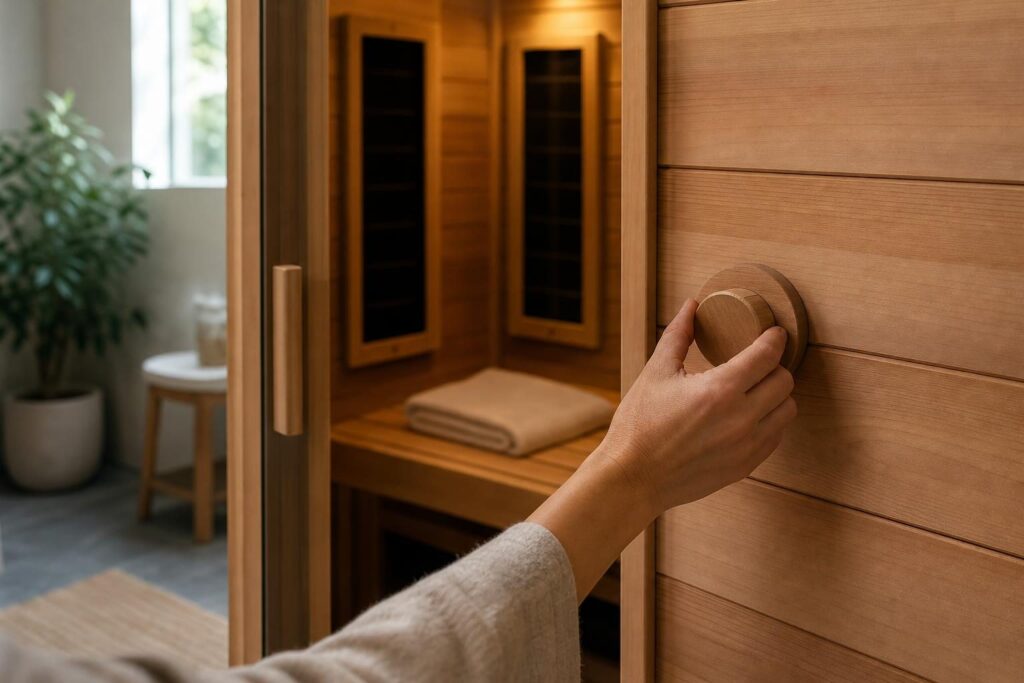
Many infrared cabins operate around 110–150°F, although available settings and actual performance vary. Reaching the upper end may take longer in a cool room, and some products are designed for different temperature ranges.
Warm-up may take tens of minutes, but there is no reliable universal figure. Cabin size, heater output, room temperature, insulation, and your chosen setpoint all affect it. Ask how the manufacturer measured any advertised warm-up time.
You may feel radiant warmth before the air reaches the selected temperature. The display usually measures air near a sensor, not your body temperature or the radiant intensity at every seat.
A cautious first-session routine
- Read the manual: Follow the model’s operating instructions and restrictions.
- Start comfortably hydrated: Avoid beginning a session already dehydrated.
- Use a modest setting: Do not aim for maximum heat on your first attempt.
- Keep it brief: Around 5–10 minutes may be a cautious starting point for an otherwise healthy adult, provided it feels comfortable.
- Leave if you feel unwell: Dizziness, nausea, headache, unusual weakness, palpitations, or chest discomfort are reasons to stop.
- Cool down gradually: Rest and replace fluids afterward.
Do not treat a longer session or heavier sweating as a performance goal. Avoid alcohol and sauna use when ill or dehydrated, and never sleep in the cabin.
Ask a clinician before use if you are pregnant, have a significant medical condition, have impaired heat sensation or sweating, or take medication that affects blood pressure, hydration, or temperature regulation.
Keep maintenance simple
Sit on a clean towel, remove damp textiles afterward, and wipe surfaces according to the manual. Let the cabin dry between sessions. Avoid soaking the wood or applying household finishes and cleaners unless the manufacturer approves them.
8. Use a Final Buying Checklist
Before ordering, compare shortlisted models using the same questions. This makes it easier to distinguish meaningful differences from marketing extras.
- Experience: Do you prefer infrared warmth to the hotter-air experience of a traditional sauna?
- Fit: Have you checked interior seating dimensions, exterior dimensions, and the delivery route?
- Capacity: Will one or two people actually be comfortable?
- Heating: Are heater placement, spectrum claims, and controls clearly explained?
- Installation: Does the room meet location, clearance, floor, and electrical requirements?
- Safety: Is relevant product certification documented?
- EMF information: If important to you, are test methods and seated-position readings available?
- Total cost: Have delivery, installation, electricity, and potential service charges been included?
- Support: Are replacement parts, warranty procedures, and return conditions clear?
If possible, arrange a demonstration. Ten minutes sitting on the bench can reveal more about headroom, back support, heater intensity, and door access than a long feature list.
9. Conclusion: Choose for Fit, Comfort, and Reliable Use
The right infrared sauna for home is one that fits your space, suits your preferred heat experience, and has clear installation and support requirements. Start with size, electrical compatibility, heater coverage, and build quality. Then decide whether full-spectrum output, premium controls, or other extras genuinely improve the experience you want.
A comfortable, well-supported cabin that you can use safely is a stronger purchase than an impressive specification sheet that does not suit your home.