

Traditional sauna heaters create the hot, stone-warmed environment that defines a classic sauna. Whether powered by electricity or burning wood, the heater must suit the room, support safe installation, and deliver the kind of sauna sessions you enjoy. This guide explains the main options, how to size and position them, and what to know about controls, stones, water, and everyday ownership.
How Traditional Sauna Heaters Work
A traditional sauna heater warms the room and a bed of sauna stones. Electric models use heating elements, while wood-burning stoves use a firebox to transfer heat into the stove body, stones, and surrounding air.
The stones store heat and provide a surface for evaporating water. When you ladle water onto properly heated stones, it creates a brief burst of steam, often called löyly. This temporarily increases humidity and makes the heat feel more intense.
A traditional sauna is not a steam room. Its background humidity is usually relatively low, with short increases when water is added. It also differs from an infrared sauna, which primarily uses infrared emitters rather than a hot stone heater.
What determines the feel of the heat?
- Heater output: The heater must supply enough heat for the room and its heat losses.
- Stone capacity and design: These influence heat storage, warm-up behavior, and how water evaporates.
- Room layout: Bench height, ceiling height, and heater placement affect how bathers experience the heat.
- Ventilation: Correct airflow supports comfort, temperature distribution, and safe operation.
A bigger heater or a larger stone basket is not automatically better. The best result comes from matching the complete heating system to the room.
Electric Sauna Heaters: Convenient Heat for Home Use
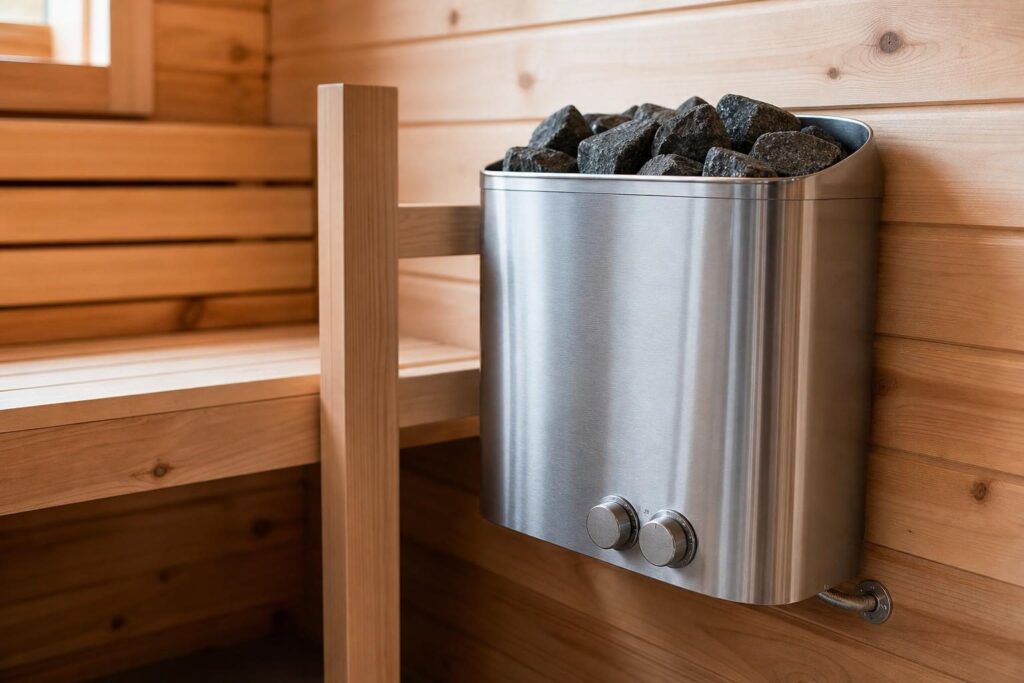
Electric sauna heaters are a practical choice where a suitable electrical supply is available. They require no firewood or chimney, and temperature control is generally more straightforward than with a wood fire.
Designs range from compact wall-mounted units to large floor-standing heaters with exposed stone baskets. Some have controls on the heater itself; others use a separate control panel and associated equipment.
Choosing an electric heater for a small home sauna
For a small sauna, look beyond the heater’s physical size. A compact model still needs its specified safety clearances, and its output must match the manufacturer’s room-volume range.
- Check the required voltage, phase, circuit capacity, and wiring arrangement.
- Confirm that the heater fits without narrowing the entrance or crowding benches.
- Compare stone capacity and loading instructions, not just power ratings.
- Check whether controls, sensors, and required control equipment are included.
- Consider local servicing, warranty support, and replacement-element availability.
The best electric sauna heaters for small home saunas balance room compatibility, usable space, and simple operation. Choosing the smallest available unit can backfire if the room has substantial glass or other heat-absorbing surfaces.
Where the Harvia Cilindro fits
The Harvia Cilindro is an established electric heater range known for its tall, exposed stone-basket design. Its substantial stone load is a key attraction for people who enjoy frequent water application.
However, Cilindro versions differ in output, controls, dimensions, and installation requirements. Evaluate the exact model rather than assuming every Cilindro uses the same electrical setup or includes the same controls. Its stone loading and required clearances also deserve careful attention.
Wood-Burning Sauna Stoves: Firewood Heat and Off-Grid Potential
A wood-burning sauna stove offers the sound, smell, and ritual of tending a fire. It can also heat a sauna without relying on an electrical supply, making it attractive for suitable cabins and remote outdoor buildings.
The trade-off is greater installation complexity and more hands-on operation. A wood-fired setup needs an appropriate chimney system, combustion air, fire protection, and a safe way to manage fuel and ash.
What to consider for an off-grid sauna
The best wood-burning sauna stoves for off-grid setups are not simply the largest or most rugged-looking. They must match the room and work with a safe, compliant chimney arrangement.
- Fuel supply: You need a dependable source of dry, suitable firewood.
- Chimney route: Roof and wall penetrations require approved components and correct clearances.
- Floor protection: Combustible floors may need a specified protective base or hearth assembly.
- Combustion air: The stove requires an adequate air supply that works with the sauna’s ventilation.
- Local restrictions: Building rules, emissions requirements, and seasonal fire restrictions may affect use.
Where the Harvia M3 fits
The Harvia M3 is a wood-burning sauna stove intended for smaller sauna rooms. It is a useful example of a compact stove, but its suitability still depends on the manufacturer’s permitted room range, clearance requirements, floor protection, and chimney specifications.
Do not assume that a compact firebox means a compact installation. The surrounding safety space can have a major effect on the room layout.
Electric vs. Wood-Burning: Cost, Convenience, and Heat
Both electric and wood-burning traditional sauna heaters can provide satisfying heat and steam. The difference is often less about which fuel is inherently better and more about installation conditions and your preferred routine.
| Consideration | Electric heater | Wood-burning stove |
|---|---|---|
| Daily operation | Set controls and allow the sauna to warm up | Light, establish, and tend the fire |
| Main installation needs | Suitable electrical supply, controls, and safe placement | Chimney, combustion air, fire protection, and safe placement |
| Temperature management | Usually regulated automatically | Managed through firing practices and approved air controls |
| Routine cleaning | Stone debris and general heater-area cleaning | Ash, soot, chimney maintenance, and stone debris |
| Off-grid suitability | Depends on an adequately sized electrical system | Can operate without electricity, depending on the setup |
Compare total installed cost, not just the heater price. An electric installation may need a supply upgrade or substantial cable run. A wood stove may require a chimney, protective assemblies, and additional building work.
Running costs depend on local electricity prices, firewood costs, room insulation, weather, session length, and usage habits. Free firewood can still involve considerable cutting, drying, storage, and handling.
Neither fuel guarantees a particular quality of steam. Stone temperature, heater design, water quantity, and room conditions all matter.
Sizing the Heater and Choosing Its Position
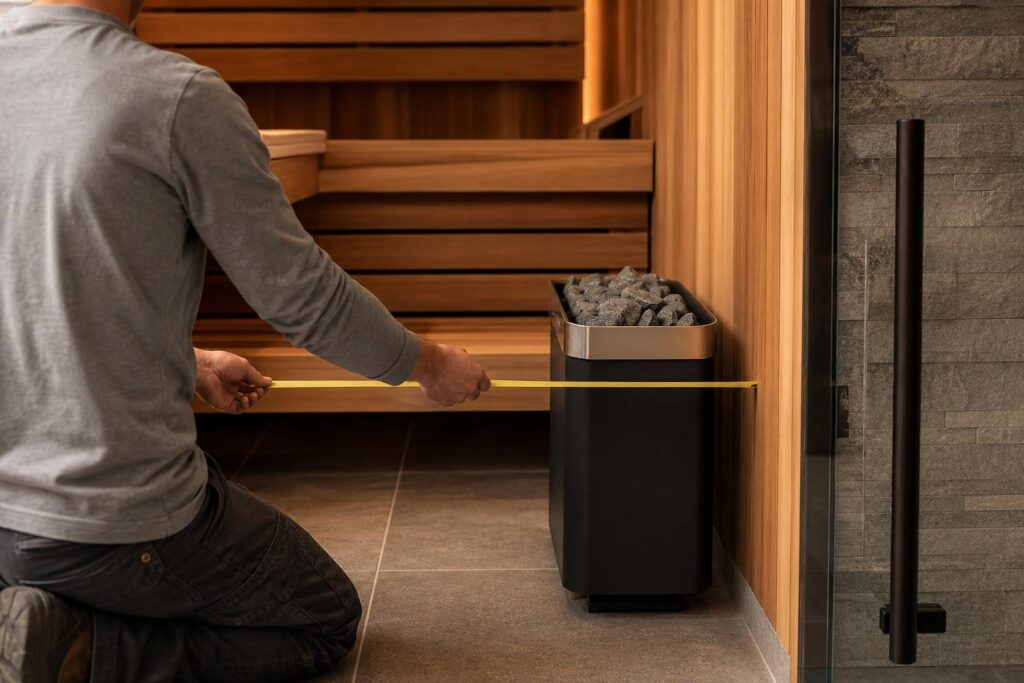
Correct sizing starts with the sauna’s internal dimensions. Multiply length by width by height to calculate room volume, using the units specified in the heater documentation.
Then account for surfaces that increase heating demand. Glass doors, windows, masonry, and poorly insulated construction can make a room behave like a larger space. Manufacturers commonly provide a method for calculating an adjusted room volume.
A reliable sizing process
- Measure the finished interior, not the outside of the building.
- Identify glass, masonry, and other surfaces requiring an adjustment.
- Apply the chosen manufacturer’s sizing method.
- Select a heater whose approved room range covers the adjusted volume.
- Confirm electrical or chimney feasibility before buying.
An undersized heater may struggle to bring the room and stones to useful operating temperatures. An oversized heater can also perform poorly if the air reaches the thermostat setting before the stone mass is adequately heated. Avoid arbitrary oversizing.
Wall-mounted vs. floor-standing heaters
Wall-mounted electric heaters can preserve useful floor space, but they need suitable structural support and specified distances from the floor, benches, and surrounding materials.
Floor-standing heaters often accommodate larger stone loads or a different visual layout. They still need adequate support, safety clearances, and access for maintenance.
Neither format is automatically better for a small room. Compare the complete installed footprint, including clearances and any required guard. Do not reduce clearances with improvised shielding; use only arrangements approved for the heater and accepted under local requirements.
Controls, Ventilation, and Safe Installation
Built-in vs. external heater controls
Built-in controls keep the operating interface on the heater and may simplify the equipment package. However, their position can be less convenient to reach, especially in a tight layout.
External controls offer more flexibility in everyday use, but they must be installed in an approved location. Depending on the system, they may require a separate power unit, sensors, and additional wiring.
Confirm exactly what is included and which components are compatible. A heater advertised as suitable for external control may not include the controller.
Electrical and fire safety
Electric sauna heaters commonly require a dedicated, correctly rated electrical installation. Have a qualified electrician follow the heater instructions and applicable local rules, including requirements for protective devices and heat-resistant wiring where specified.
For wood-burning stoves, use a qualified installer familiar with sauna appliances and chimney systems. Chimney clearances, penetrations, hearth construction, and nearby combustible materials all need careful assessment.
Ventilation must suit the heater type, room design, and manufacturer’s instructions. A generic vent diagram is not suitable for every sauna, particularly when combustion air or mechanical ventilation is involved.
- Keep towels, clothing, buckets, and other objects off the heater.
- Fit any required heater guard without obstructing airflow or access.
- Install appropriate smoke and carbon monoxide detection as required, in locations suitable for the devices’ operating limits.
- Use remote-start functions only with the manufacturer’s required safety equipment and procedures.
Sauna Stones, Airflow, and Pouring Water
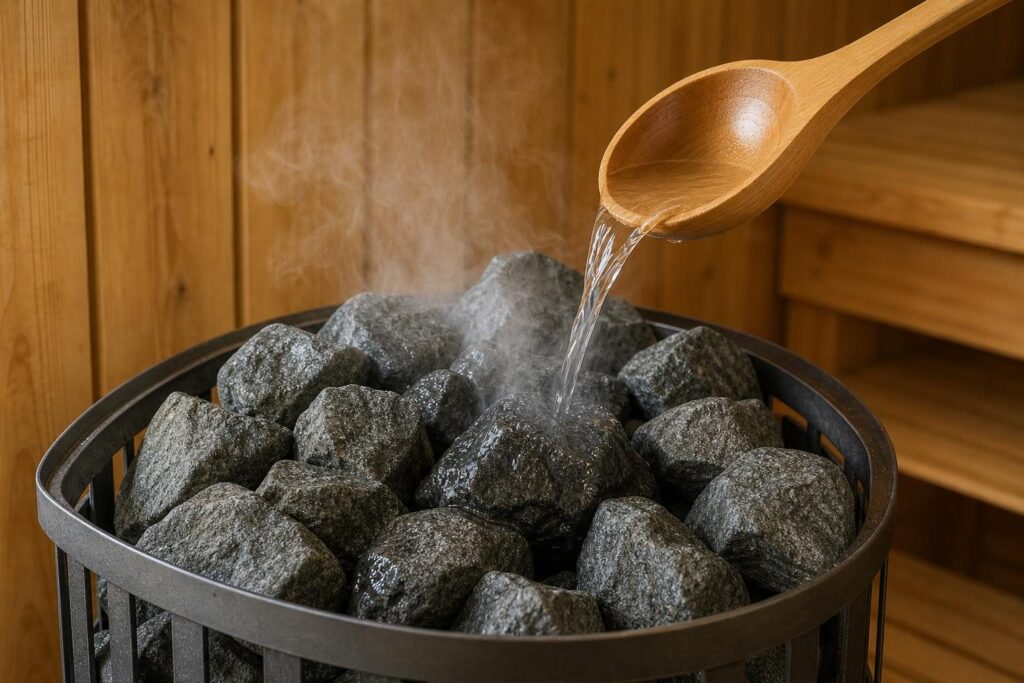
Stones are working components, not just decoration. Their material, size, condition, and arrangement affect airflow, element temperatures, heat storage, and steam production.
How to load sauna stones
Use only stones approved for sauna use and suitable for the specific heater. Random garden or river stones may crack, deteriorate, or behave unpredictably under repeated heating.
- Check the manual for the required stone type, size, and quantity.
- Rinse off stone dust and allow the stones to drain.
- Load them in the specified arrangement, leaving the necessary airflow paths.
- Avoid forcing stones between electric elements or bending the elements.
- Cover or expose components only as directed by the manufacturer.
Stone-loading instructions vary between open-basket heaters, compact electric units, and wood-burning stoves. Packing every gap tightly is not a universal route to better steam and can restrict airflow.
Can you pour water on an electric sauna heater?
Yes, if that specific heater is designed for it. Many traditional electric sauna heaters are intended to receive water on their stones. Always follow the manual’s limits for water quantity, quality, and application.
Use a ladle to apply a modest amount to the designated stone area. Stand clear of rising steam and keep water away from controls and other areas not intended to get wet. Repeated large pours can cool the stones and produce an unpleasant burst of steam.
Do not add essential oils, fragrances, or other substances directly unless the heater manufacturer explicitly permits the product and method. Saltwater and unsuitable water chemistry can damage equipment.
Maintenance and Choosing the Right Heater
All traditional sauna heaters need periodic attention. Allow the heater to cool fully before cleaning or inspecting it, and isolate electrical equipment as instructed before maintenance.
- Inspect stones: Remove fragments and replace crumbling or damaged stones. Reload them at the intervals recommended for the heater and usage level.
- Keep airflow paths clear: Clean accumulated debris from accessible areas according to the manual.
- Check electric equipment: Have damaged elements, wiring, sensors, or controls assessed by a qualified professional.
- Maintain wood-fired systems: Arrange chimney inspection and cleaning as required, and monitor stove and flue condition.
- Handle ash safely: Place cooled ash in a suitable metal container with a lid, away from combustible materials; hidden embers can remain hazardous.
Before choosing a heater, write down your adjusted room volume, available utilities, installation constraints, and preferred operating routine. Then compare models that meet those essentials.
Choose electric if straightforward control and minimal fuel handling are priorities. Consider wood-burning if tending a fire is part of the appeal and your location supports a safe, compliant installation. In either case, prioritize clear documentation and service support over appearance alone.
Conclusion
The right traditional sauna heater fits the room, the available infrastructure, and the way you want to use your sauna. Start with accurate sizing and installation requirements, then compare fuel type, mounting style, controls, and stone capacity. Careful installation, correct stone loading, and routine maintenance matter just as much as the heater you choose.